Wellbeing Begins Close to Home
Wellbeing begins with ourselves, those close to us and the environment immediately around us. When we tend to that, we become a source of strength within ourselves, for the people we meet and the natural world we’re part of.
Then The Ripples Begin
When enough of us do this, something bigger happens: those individual acts of care ripple outward, weaving into stronger, more connected communities.
Spreading Wider Wellbeing
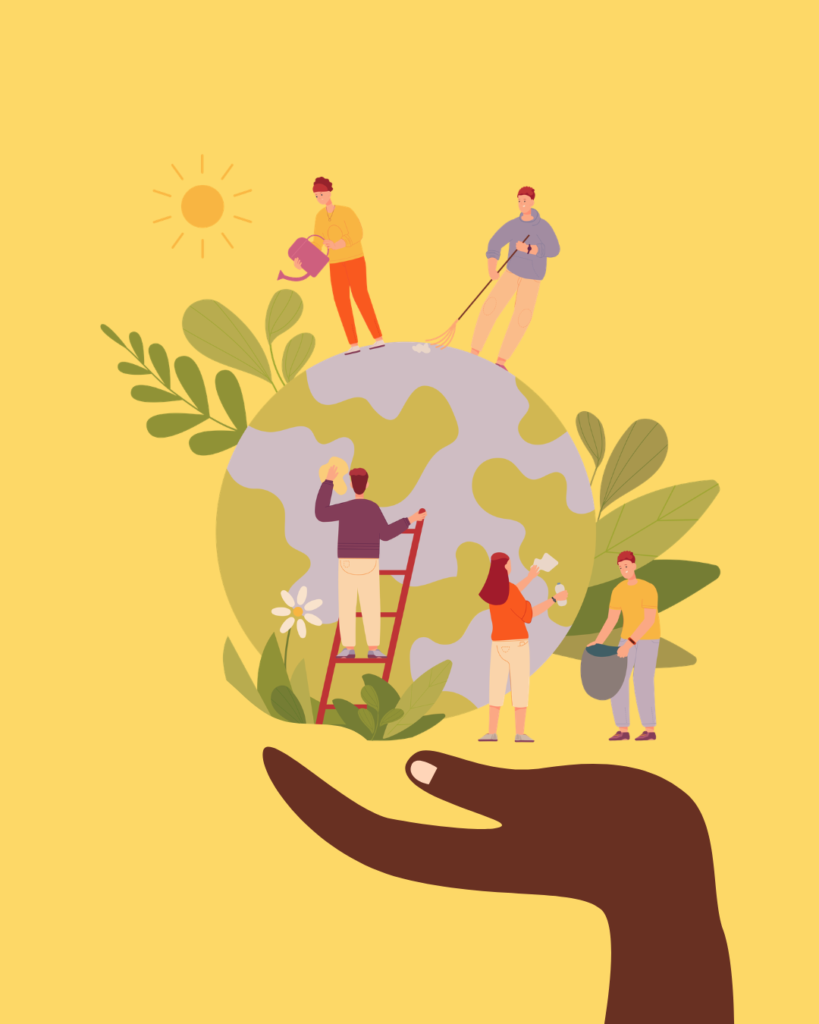
And when communities flourish, they don’t stop there – they shape the wider systems, cultures and structures we all live within. Personal wellbeing becomes collective wellbeing. Collective wellbeing becomes societal change.
To solve the current global crises we are facing, we need to start measuring success differently.
Wellbeing as the New Measure of Success
Money has long been the measure of success. For the last 80 years, it’s been made official – governments worldwide tracking ‘success’ and ‘progress’ through GDP (Gross Domestic Product).
Gross Domestic Product is a single number that adds up everything a country produces and earns. But GDP only tells a small part of the story, through one narrow, financial lens. It measures wealth and productivity, but it doesn’t count what actually makes life good: whether people feel happy and have what they need for a good quality of life, whether communities feel connected, or whether the natural world is thriving.
A country’s GDP can rise – indicating success – while people quietly suffer, communities grow more isolated, forests are stripped bare, rivers poisoned, species pushed to the edge of extinction.
Since the industrial revolution, this incredible planet we all share and rely on for survival has been used as a resource to exploit for the wealth of a few in the pursuit of endless growth. This has brought extreme wealth for some and extreme poverty for much of the world, alongside a climate crisis and the mass extinction of the species and ecosystems we depend on to survive and thrive.
We are now living with the collateral damage of this model for success. In short: we’ve been measuring the wrong things.
But there are other ways we could be measuring what matters…
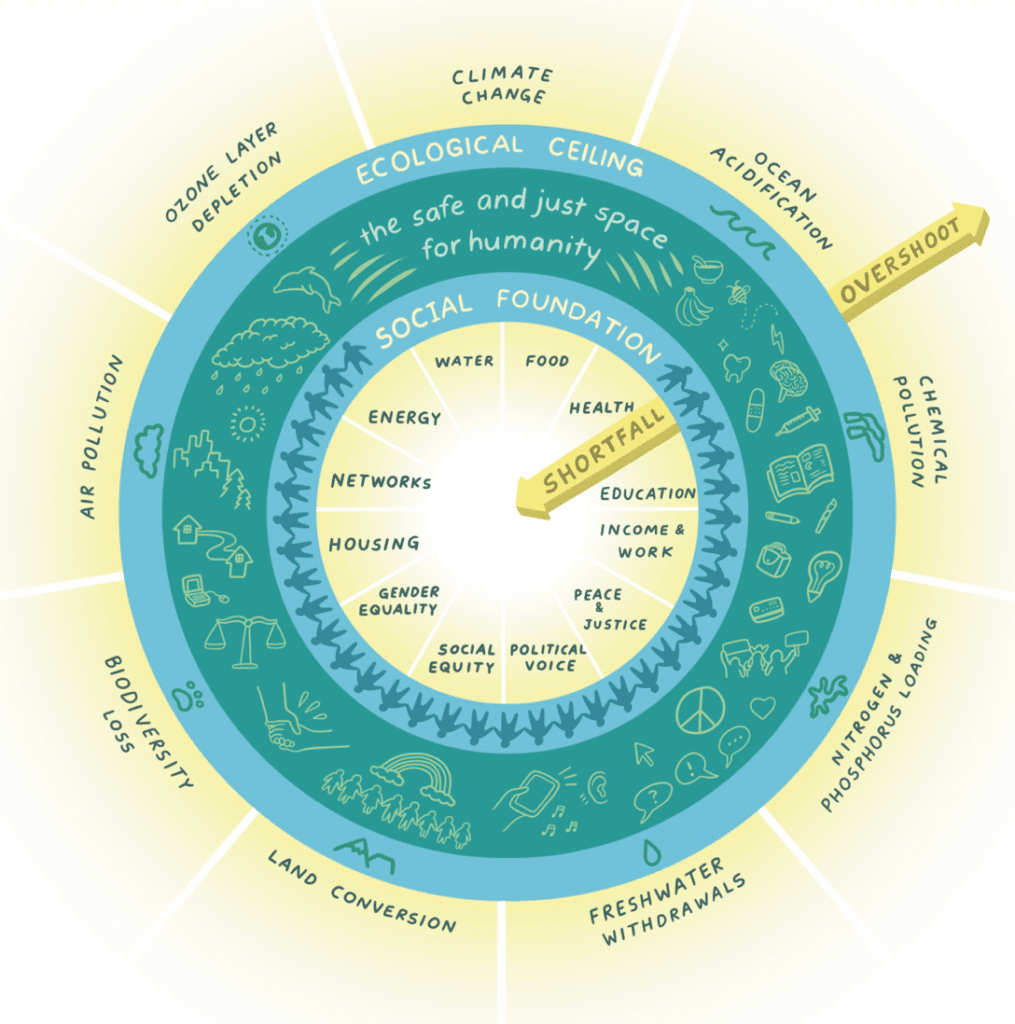
What is the Doughnut all about?
The Doughnut of Social and Planetary Boundaries (the Doughnut) offers a visual monitor of progress towards the goal of meeting the needs of all people within the means of the living planet.
At its conceptual core, the Doughnut consists of two concentric rings: a social foundation, to ensure that no one is left falling short on life’s essentials, and an ecological ceiling, to ensure that humanity does not destabilise the life-supporting systems that sustain all life on Earth.
Between these two sets of boundaries lies a doughnut-shaped space that is both ecologically safe and socially just: a space in which humanity can thrive.
The Doughnut is a core concept of Doughnut Economics. Click below to learn more about how the Doughnut has evolved since it was first created by Kate Raworth in 2012, and to explore interactive results of the latest quantitative assessment published in 2025.
This all sounds very nice but what can I do about it?
What you can do now
The scale of the challenges we currently face can feel overwhelming. But there is much evidence that human beings are a keystone species – not a plague on the planet. We have the power to choose how we interact with the world, as we have shown throughout human history. For hundreds of thousands of years, we have lived within the web of life and the natural planetary limits. It is only in the last 250 years that this has changed.
Widespread social change has always begun with a small group of determined people who decided to take action towards the change they wanted to see in the world. No longer waiting and hoping. Acting with radical hope.
But we are no longer a ‘small group’! Those cultivating wellbeing across the UK have become a tidal wave of positive action – and it continues to grow every day.
Here is what history tells us, over and over: communities move first. The Civil Rights Movement, Women’s Rights, LGBTQ+ equality – none of these tidal shifts began in parliament. They began in kitchens and community halls, with ordinary people finding each other, deciding that enough was enough, and taking action. Policy followed – sometimes decades later. It always does, once the tide has already been turned by the masses.
If you can find it – join it. If you can’t find it – make it.
Find the organisations working for the things you believe in. Show up. Offer your hands, your time, your skills – not necessarily your money, just you. Swap and share and grow with the people around you. Stop waiting for someone else to build the neighbourhood, the community, the world you want to live in.
It is time to let go of the isolated, passive consumer story. Step into something far richer and far older: the story of people who make things together, look out for each other, and build the world they want future generations to inherit.
There is no ‘us and them’ in that story. There is only us.
Humankind – being kind to ourselves, to each other and to the earth. Because we belong to each other. We belong to this earth. And somewhere beyond the noise and petty divisions, every single one of us already knows it.
It’s time to start acting like it – so get involved!
“We need joy as we need air.
We need love as we need water.
We need each other as we need the earth we share.”
– Maya Angelou

Free Wellbeing Resources Library
Explore our library of free resources, toolkits, videos, podcasts, events and courses which can support you to build wellbeing for yourself and the community where you live. And you can add your own resource!
UK Directory of Wellbeing Opportunities
Explore our directory of wellbeing opportunities, projects and practitioners across the whole of the UK. Type in your postcode and find out what’s happening near you! You can also add your own marker on the map!